PMOS & Training: When Your Body Doesn’t Play by the Same Rules
And why exercise can be both one of the hardest things to do — and one of the best things you can do.
If you’ve been following Apparently We’re Doing This, you’ll know that I recently decided to drag myself back into the world of exercise.
Gym. Cardio. Leg days. Questionable life choices involving treadmills.
The whole lot.
What I haven’t really spoken about seriously is the other thing that comes to the gym with me every single time.
PMOS.
You might know it by its old name, PCOS — Polycystic Ovary Syndrome. In 2026, PCOS was renamed Polyendocrine Metabolic Ovarian Syndrome, or PMOS.
And I actually think the new name matters.
Because for years we’ve been calling this thing an ovary syndrome, when anyone living with it can tell you that it has a rather annoying habit of involving your entire bloody body.
Hormones.
Metabolism.
Insulin.
Periods.
Weight.
Skin.
Hair.
Sleep.
Mood.
Energy.
Fertility.
And then, just for fun, your relationship with your own body.
So when someone with PMOS decides to start exercising, there can be a little more going on behind the scenes than simply:
Eat less. Move more.
If only it were that bloody simple.
First, what exactly is PMOS?
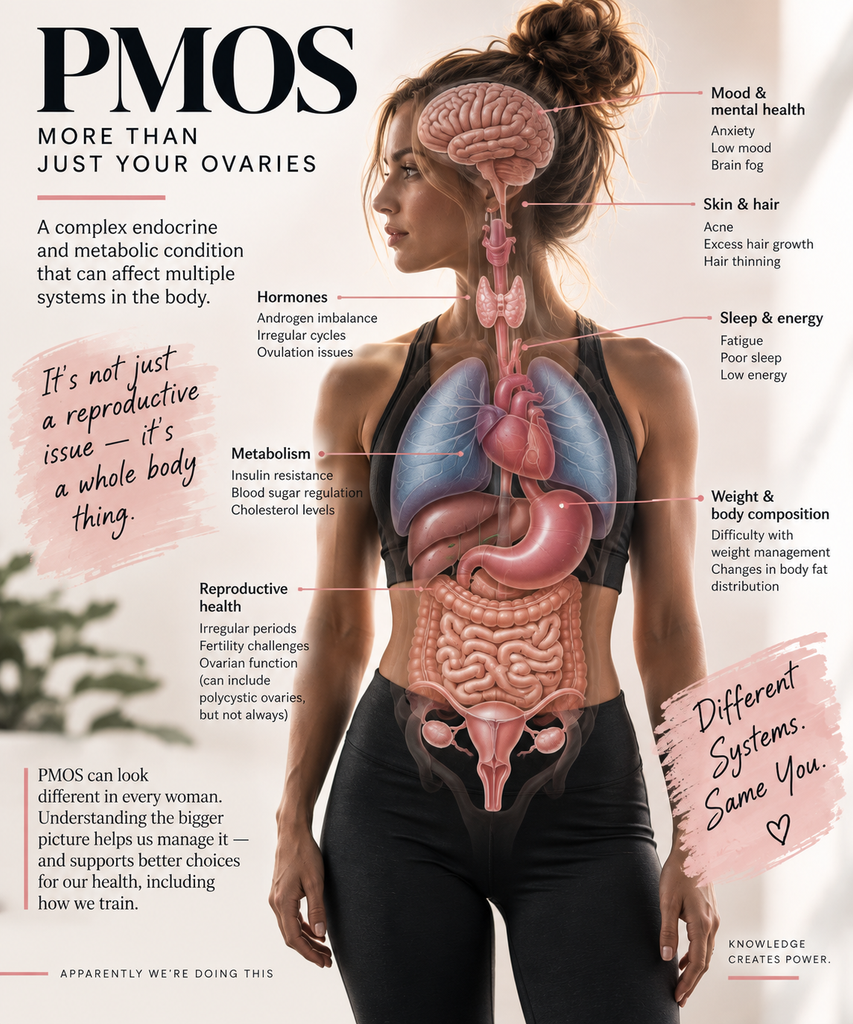
PMOS is the new name for the condition previously called PCOS.
The change doesn’t mean we’ve suddenly discovered a new disease. If you were diagnosed with PCOS, you haven’t magically acquired something different.
The name was changed because the old one didn’t properly describe what the condition actually is.
Despite the name polycystic ovary syndrome, ovarian cysts aren’t actually required for a diagnosis. PMOS is a complex endocrine and metabolic condition that can affect multiple systems in the body.
That word metabolic is particularly important when we’re talking about exercise.
One of the things commonly associated with PMOS is insulin resistance.
Insulin helps move glucose from your bloodstream into your cells, where it can be used for energy. When the body becomes less responsive to insulin, it has to work harder to manage blood glucose.
And suddenly the conversation about weight, hunger, energy and exercise becomes considerably more complicated than:
“Just have some self-control.”
Thank you, Susan.
Very helpful.
So… does PMOS actually make training harder?
This is where I want to be careful.
Because I don’t want this article to become an excuse.
I also don’t want it to become another one of those articles telling women that if we simply manifest hard enough, drink three litres of water and wake up at 5am, our hormones will politely fall into line.
There is a middle ground.
PMOS doesn’t mean that you can’t become fit.
It doesn’t mean you can’t become strong.
It doesn’t mean you can’t lose weight.
And it certainly doesn’t mean exercise “doesn’t work” for women with PMOS.
But some of the things associated with PMOS can make getting there more complicated.
Fatigue can make getting yourself through the gym door difficult before the workout has even started.
Poor sleep can affect recovery.
Insulin resistance and metabolic dysfunction can influence weight management.
Irregular or difficult menstrual cycles can mean that how you feel physically isn’t wonderfully predictable from one week to the next.
Then there is the psychological side of it.
PMOS is associated with increased psychological and emotional challenges, and body image deserves a mention here too.
Because exercising when you already feel uncomfortable in your body is very different from exercising because you love showing it off in Lycra.
Trust me.
I am currently very familiar with the oversized-T-shirt school of athletic fashion.
But what if you’re already fit?

Something else came up while I was looking into all of this that I don’t think we talk about nearly enough.
I spoke to a group of women with PMOS who aren’t just occasionally going to the gym.
These women train consistently.
They train for events. They run. They lift weights. They know their bodies, they know what they’re normally capable of, and they know the difference between being a little tired and something feeling completely off.
And fatigue wasn’t the only thing they mentioned.
One of the biggest things that came up was inconsistency in strength and performance.
One training session, a 10kg dumbbell curl can feel light. Everything works. The strength is there and the body does exactly what it’s being asked to do.
Another session?
Half that weight can feel like it has personally declared war.
Same person.
Same training.
Same muscles.
Very different experience.
And it isn’t only strength training.
The runners described exactly the same sort of unpredictability with their cardio.
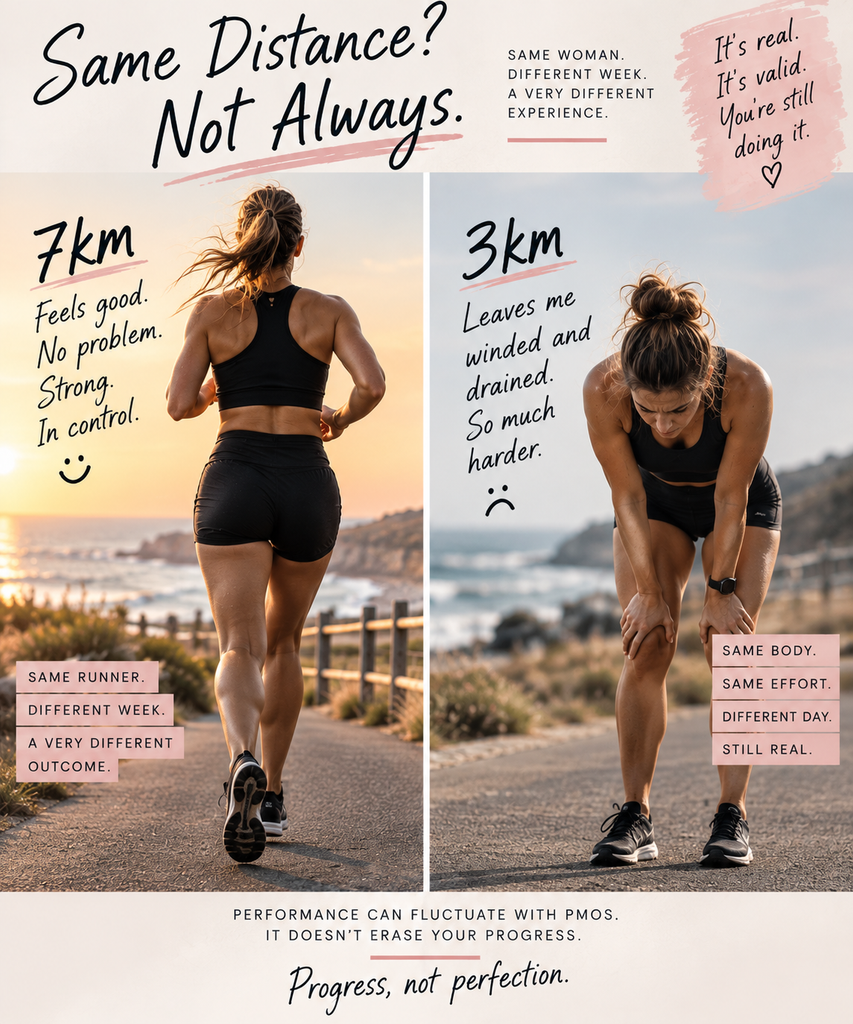
One week, someone can run 7km comfortably, finish feeling good and wonder what all the fuss was about.
Then another week, 3km leaves her winded, exhausted and completely drained.
When you’re somebody who trains regularly, that can seriously mess with your head.
Because your immediate thought isn’t necessarily:
“My hormones might be affecting how I feel today.”
It’s:
What the hell happened to my fitness?
Did I lose strength?
Am I getting unfit?
Did I do something wrong?
Why could I do this last week and suddenly I can’t?
And naturally, these women have tried to find the pattern.
Is it my menstrual cycle?

That’s where things get even more complicated.
There is plenty of discussion in women’s sport and exercise about training around the menstrual cycle and whether hormonal fluctuations across different phases can influence things like perceived exertion, recovery, body temperature and performance.
So naturally, you start looking at your cycle.
Maybe it’s the luteal phase.
Maybe it’s the week before your period.
Maybe there’s a predictable point every month where strength or endurance drops.
Except…
What cycle?
For many women with PMOS, periods aren’t regular enough to neatly mark off Day 1, Day 14, luteal phase, follicular phase and start planning your training calendar accordingly.
Ovulation may be irregular.
Cycles can be unusually long.
Periods can disappear for months.
Hormonal patterns may not follow the wonderfully tidy 28-day diagram we’ve all seen approximately four thousand times.
So you’re left trying to solve a hormonal jigsaw puzzle without half of the pieces.
Was that terrible run because I’m in my luteal phase?
Is this a PMOS-related symptom?
Did I not recover properly?
Did I sleep badly?
Did I eat enough?
Am I stressed?
Is today simply a rubbish training day?
Or is it some combination of all of them?
And this is where I think we have to admit that sometimes we simply don’t know.
Research into menstrual-cycle phases and athletic performance is still developing, and women don’t all respond in exactly the same way. Add PMOS, irregular ovulation and irregular menstrual cycles into the equation and confidently blaming one terrible workout on one particular hormonal phase becomes even more difficult.
But that doesn’t mean the experiences should be dismissed.
When women who train consistently tell you:
“Some days I have my strength and some days I just don’t.”
Or:
“Last week I ran 7km. Today 3km destroyed me.”
That’s worth talking about.
Not because it proves PMOS caused that particular workout.
But because performance variability is something real women with PMOS are trying to navigate.
And perhaps the answer isn’t perfectly predicting every hormonal fluctuation.
Maybe it’s learning that our training occasionally needs to have room to move with us.
If 10kg isn’t happening today, use 5kg.
If 7km isn’t happening, do 3km.
If you’re unusually exhausted, pay attention to it.
Adjusting one session doesn’t erase all the training that came before it.
And one unexpectedly difficult workout doesn’t mean you’ve suddenly lost your fitness.
Your worst training day is not an accurate measurement of what your body is capable of.
The cruel little PMOS contradiction
And here’s the part I find fascinating.
Some of the very symptoms that can make exercise harder are also reasons why exercise can be so beneficial.
PMOS can make you not want to exercise.
And exercise can help manage important aspects of PMOS.
Rude, really.
Physical activity is considered an important part of PMOS management because of its effects on metabolic health, body composition, cardiovascular health and general wellbeing.
Exercise can improve insulin sensitivity — essentially helping your body respond to insulin more effectively.
And that matters whether you lose 20 kilograms, 2 kilograms or absolutely nothing that particular week.
I think that’s incredibly important.
Because we have been taught to judge exercise by one ridiculously small measurement:
What does the scale say?
You train for a week.
You eat better.
You avoid the brownie that’s been whispering psst from across the kitchen.
You get on the scale.
Nothing.
And immediately:
“Well, this clearly isn’t working.”
Except something may very well be working.
Your fitness may be improving.
Your cardiovascular health may be improving.
Your muscles may be getting stronger.
Your insulin sensitivity may be improving.
Your body composition may be changing.
Your mental wellbeing may be benefiting.
The scale simply isn’t capable of reporting any of that.
It only knows how heavy you are.
That’s it.
We have somehow given one very basic bathroom appliance an enormous amount of authority.
Do women with PMOS need a special type of exercise?
This was one of the questions I really wanted an answer to.
Should we be lifting weights?
Doing cardio?
HIIT?
Walking?
Should we be avoiding intense exercise because of cortisol?
Is there a magical “PMOS workout” we’re all supposed to be doing?
And this is where the actual evidence is refreshingly boring.
There currently isn’t good evidence showing that one particular type or intensity of exercise is universally superior for women with PMOS.
In other words:
There isn’t one magical PMOS workout.
Evidence-based guidance supports physical activity that is sustainable and suited to the individual woman’s preferences, circumstances and goals.
And I love that.
Because the best exercise programme in the world is absolutely useless if you hate it so much that you stop doing it after two weeks.
For one woman, that might be walking.
For another, swimming.
For someone else, weight training.
Running.
Cycling.
Hockey.
A combination of strength and cardio.
Or dancing around the lounge while your children question whether they should call somebody.
It counts.
Strength training deserves a seat at the table
Personally, I’m developing a slightly complicated relationship with strength training.
By complicated I mean:
I hate it while I’m doing it.
I complain about it afterwards.
And then I feel ridiculously proud of myself when I realise I’m getting stronger.
Resistance training is particularly interesting because building and using muscle plays an important role in metabolic health.
Skeletal muscle is a major site for glucose uptake, and regular resistance training can improve muscular strength while contributing to overall metabolic health.
And for women who have spent years being told that exercise is something we do purely to make ourselves smaller, there’s something rather wonderful about changing the objective.
Not:
How small can I become?
But:
How strong can I become?
That’s a very different relationship with exercise.
And then there’s cardio…
Ah yes.
My nemesis.
The treadmill.
Cardiovascular exercise has obvious benefits for heart and lung fitness, but it can also contribute to improved metabolic health and insulin sensitivity.
That doesn’t mean you have to run.
Walking counts.
Cycling counts.
Swimming counts.
Intervals count.
Sport counts.
The goal is movement — preferably movement that you can realistically continue doing.
Exercise guidelines generally recommend around 150–300 minutes of moderate-intensity activity per week, or 75–150 minutes of vigorous activity, together with muscle-strengthening exercise on at least two days.
But I think there’s an important sentence that needs to come immediately after those numbers:
You don’t have to start there.
If you’ve been sedentary, exhausted and struggling with your health, looking at “300 minutes per week” is a fantastic way to decide you’ll start next Monday.
And then next Monday.
And perhaps the Monday after that.
Some movement is better than none.
Ten minutes matters.
A walk matters.
One workout matters.
You build from there.
What about weight loss?
This is probably the most emotionally loaded part of the conversation.
Because PMOS and weight are almost impossible to discuss without somebody eventually telling you to lose some.
And yes, for women who are carrying excess weight, weight reduction can sometimes improve metabolic and reproductive outcomes.
But exercise should not be reduced to punishment for being overweight.
Nor should its success be measured exclusively by kilograms lost.
You can improve your health before you’ve reached your goal weight.
Read that again.
You can become healthier before you become thinner.
For me, that’s a pretty important distinction.
I have weight I want to lose.
I’m not pretending otherwise.
I have goals.
But I’m also training because I want my body to do things again.
I want stamina.
I want strength.
I want energy.
I want to return to hockey.
I want to feel capable.
And I’d quite like to walk up a flight of stairs without my lungs filing a formal complaint.
Weight loss is part of my goal.
It isn’t the entire goal.
Recovery matters too
This is the part I’m learning the hard way.
Training isn’t just what happens while you’re holding a dumbbell.
Your body has to recover from what you’ve asked it to do.
Sleep matters.
Nutrition matters.
Rest matters.
Stress matters.
And when fatigue is already something you’re dealing with, there is a difference between pushing yourself appropriately and completely flattening yourself because you think suffering means the workout was more effective.
More isn’t automatically better.
Sometimes the sensible thing is the hard workout.
Sometimes it’s the walk.
And sometimes your body is asking for a rest day.
Learning the difference between:
“I don’t feel like it.”
and
“I genuinely need recovery.”
might be one of the harder skills of all.
I’m still working on that one.
PMOS doesn’t get to own the story
This is probably the part I care about most.
Because once you’re diagnosed with something chronic, it becomes incredibly easy for it to become the explanation for everything.
Why am I tired?
PMOS.
Why isn’t the scale moving?
PMOS.
Why was my workout rubbish?
PMOS.
Why am I hungry?
PMOS.
Why am I standing in front of the fridge at 10pm contemplating cheese?
…actually, that one might just be me.
PMOS is relevant.
It is real.
Its metabolic, hormonal and psychological effects are real.
But I don’t want to hand it more power than it deserves either.
Understanding what’s happening inside my body isn’t about creating excuses.
It’s about creating better strategies.
If insulin resistance is part of the problem, let’s work on improving insulin sensitivity.
If fitness is poor, let’s build it.
If muscle helps metabolic health, let’s get stronger.
If sleep is terrible, let’s stop pretending recovery doesn’t matter.
If a programme is so miserable that I’m never going to stick to it, let’s find something I actually will.
And if today my body simply isn’t capable of what it did last week?
Adjust.
Don’t quit.
Knowledge isn’t an excuse.
It’s information.
And information gives you something to work with.
The part nobody puts on Instagram
There are going to be workouts where you feel fantastic.
There are going to be workouts where your legs feel as though someone has quietly replaced them with concrete.
There will be weeks where the scale moves.
Weeks where it doesn’t.
Days where you’re motivated.
Days where getting dressed for the gym deserves its own medal.
And if you’re living with PMOS, there may be another layer underneath all of that.
Maybe that’s the biggest thing I’m beginning to understand about training with PMOS.
Consistency doesn’t necessarily mean doing the exact same thing at the exact same intensity every single time.
Sometimes consistency means showing up and smashing the workout.
Sometimes it means reducing the weight.
Sometimes it means shortening the run.
Sometimes it means walking instead.
And sometimes consistency means taking the bloody rest day so you can come back again.
Exercise doesn’t have to be perfect to count.
You don’t need the perfect workout.
The perfect diet.
The perfect hormones.
The perfect body.
Or the perfect week.
You just need to keep finding a way back to it.
Which, now that I think about it, sounds suspiciously familiar.
Progress, not perfection.
Apparently we’re doing this.

A note from me
This article combines my personal experience, conversations with other women living and training with PMOS, and evidence-based information about the condition.
The experiences described by the women I spoke to — including fluctuations in strength, endurance and fatigue — are personal experiences and shouldn’t be interpreted as proof that PMOS caused those individual changes in performance.
I am not a doctor, dietitian or exercise physiologist, and this article isn’t individual medical advice. PMOS can present very differently from one woman to another. Decisions about your own symptoms, treatment, medication, nutrition or exercise programme should be discussed with an appropriately qualified healthcare professional.
Also Read
- Cortisol: The Stress Hormone Everyone’s Obsessed With (And What Actually Lowers It)
- The Cortisol Loop: Breaking Free from the Visceral Fat Trap
About the Author